


The Impact–Compute Paradox
A Field Report from the Competitive Frontier
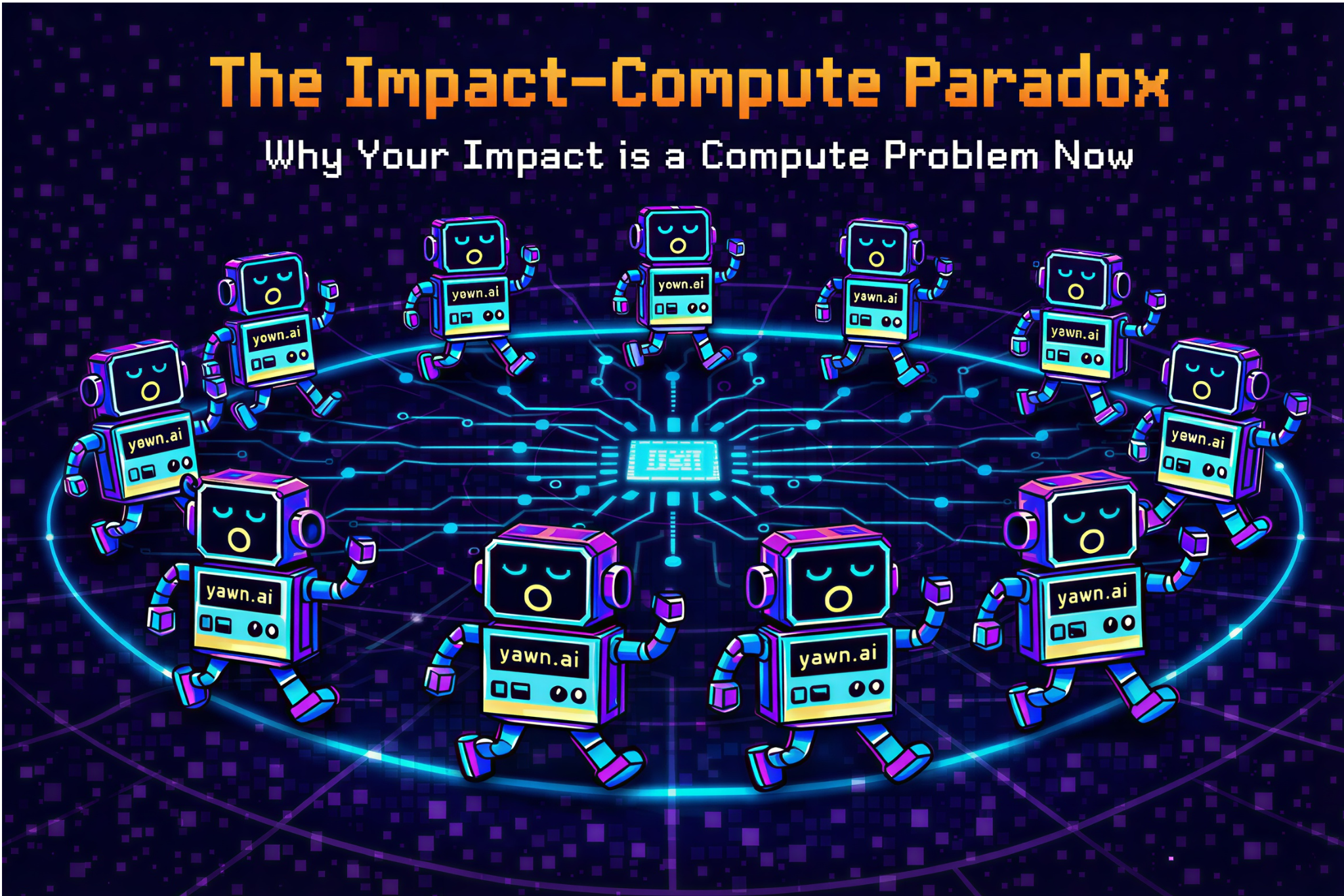
There is a direct correlation between our impact and compute.
That sentence used to sound like “AI Twitter.”
This week it started sounding like infrastructure.
Because SpaceX just absorbed xAI in a deal widely reported around $1.25T, and the stated logic isn’t subtle: push AI compute beyond Earth’s power constraints—including talk of orbital, solar-powered “data centers in space.” (Reuters)
That’s the signal.
Compute is becoming so important that the richest people on Earth are reorganizing companies and supply chains around it.
And here’s the part that matters more than the rockets:
You were already computing.
1) You’ve always been a data center (just a biological one)
If we define compute as:
input → model → output
sense → map → predict → decide → act → learn
…then human beings have been “computing” forever.
Your brain is metabolically expensive—~20% of your body’s energy while being ~2% of your mass. (brainfacts.org)
And a lot of that spend is continuous model maintenance and simulation—especially via the default mode network, which is associated with internally-directed cognition (self, memory, future-simulation, mind-wandering). (PubMed)
So yes:
Impact correlates with compute is already technically true.
Because your life is downstream of the system that turns experience into decisions.
2) The paradox: more compute can produce less impact
Here’s the Impact–Compute Paradox:
As compute increases, so does option-space.
Option-space fragments attention.
Fragmented attention collapses throughput.
So “more compute” can mean “more stuck.”
On Earth, this looks like:
more information
more tools
more tabs
more “strategies”
more AI drafts
more possible moves
And then… no proof. No closure. No compounding.
Cognitive science has receipts for the “why”:
Task switching has real costs (response time, error rate, cognitive overhead). (American Psychological Association)
Unfinished tasks create “attention residue,” where part of your mind stays latched to the previous task and degrades performance on the next. (ScienceDirect)
So the paradox isn’t a vibe. It’s a mechanism:
More available compute can increase fragmentation faster than it increases output.
3) Why space data centers are the perfect metaphor (and not just a metaphor)
Earth-bound AI has hard constraints: power, cooling, land, permitting, grids.
So now we’re watching serious players float a wild solution:
move the compute off-planet.
SpaceX has filed with the FCC for an “orbital data center” concept reportedly involving up to one million satellites—and the SpaceX–xAI merger is being framed as an accelerator for that direction. (Reuters)
Not everyone is buying it. Even within Big Tech, the skepticism is explicit: AWS leadership has publicly downplayed orbital data centers as far from practical reality, citing economics and logistics. (Reuters)
That tension is exactly why this moment matters.
Because whether or not orbital compute arrives on schedule, the signal is undeniable:
The compute race is now so intense that “data centers in space” is no longer science fiction.
It’s a line item.
4) The Effective Compute Law (the escape hatch)
Here’s the rule that resolves the paradox:
Impact scales with effective compute — not raw compute.
Effective compute is compute that is:
Aimed (one constraint, not ten curiosities)
Bounded (a real definition of done)
Closed (proof, not progress-theater)
Compounding (learning becomes rules, workflows, systems)
If your compute doesn’t produce proof, it’s not work.
It’s heat.
5) The founder version of this (read this twice)
AI is a compute multiplier.
But it’s also an option-space multiplier.
Which means the “winners” of the AI era are not the people with the most ideas.
They’re the people who can route compute without leaking it.
They do three things obsessively:
1) They pick the constraint that matters this week
Not the perfect roadmap. The current bottleneck.
2) They force reality to answer
Ship, sell, deploy, publish, demo, charge, measure. Proof.
3) They convert learning into re-usable leverage
A playbook. A workflow. An agent. A rule. A system.
That’s compounding compute.
6) A 10-minute “compute audit” you can do today
Write these four lines:
My current constraint is: ______
Proof that it’s relieved is: ______
The smallest next action is: ______
The compute leak I’m killing today is: switching / fear / infinite options
That’s it.
That’s the whole game.
Closing
SpaceX didn’t merge with xAI because “AI is cool.”
The story being told is: compute is becoming a primary resource, and Earth is starting to look like the limiting container. (Reuters)
Meanwhile your brain—the original compute engine—still has the same bottlenecks it always had:
attention, fragmentation, fear, and unfinished loops.
So here’s the real question of the compute era:
Is your compute producing proof… or producing simulation?
If you want engagement bait that’s actually real, answer this in the comments:
Where is your compute leaking right now: switching, fear, or infinite options?